Showing posts with label biology. Show all posts

Sunday, August 26, 2012

Mealworm 101

http://en.wikipedia.org/wiki/Mealworm


Great diet for reptiles, mealworms are one of the things I feed to both my lizards and my turtles. They can easily be raised. All it takes is some Red Mill Wheat Bran Flakes, and some Russet potatoes.
      You can keep them in a deep Tupperware. An empty large size washed tub from I Can’t Believe It’s Not Butter! will also work. The lid should have tiny pin sized holes in it to allow some airflow but to not let the mealworms escape, specially if it gets tipped over for some reason and they have access to the lid. The wheat bran should not be very high, but deep enough to borrow in. You may have to add more later, so keeping it at a low level will keep the beetles from crawling on the lid.
http://en.wikipedia.org/wiki/Mealworm
Mealworms are one stage in a Mealworm beetle life cycle. First there is an egg. Laid by a female beetle after procreation with a male beetle. They borrow in the wheat bran and lay these eggs, around 500 of them. After 4-20 day the mealworms should start to surface. They will be tiny, but will shed and grow larger for quite sometime before the pupa stage. This is much like a caterpillar to a butterfly. In this stage the mealworm is actual a larvae for the beetle. They will borrow and feed on dead insects and wheat bran, and will eat tunnels through the potato pieces, and get their liquid nutrients from the potato. This stage can last up to 115 days. You want your mealworms to grow to a healthy size and then select some for feeding. If you select all of them there will not be any beetles to complete the life cycle and give you more the next round. This is a delicate balance, and depends on how many mealworms you have starting, and how many your reptile eats. After being a mealworm they start to get puffy and white, they curl up and start to look like grubs a little. This pupa stage can have various lengths depending upon temperature. When the pupas are cold then they take longer to transform. Eventually a small beetle break out, and turns brown and then black. The beetles I have raised are usually about the size of my pinky finger nail. They can move fast and bite, so do not mess with these guys! Just leave them alone and pick out the mealworms when you harvest. I have never had a problem and never been bitten.
The total life cycle can take up to a year, but if you store the container of mealworms in a warmer location then they will go through the cycle faster. Mealworms are largely bred in zoos for food for both reptiles and birds. Tequila flavored candies are made with meal worms for flavoring. Meal worms are also edible. Most of the ones from the pet stores are hormone injected, and will not complete a life cycle and become a beetle because of this. You should be able to ask for non-hormone injected meal worms at the store, or ask for the person they may get their me.

Sources:

T, Pragya. "Mealworm Life Cycle." Buzzle.com. Buzzle.com, 2012. Web. 26 Aug 2012. <http://www.buzzle.com/articles/mealworms-life-cycle.html>.

Thursday, August 23, 2012

Evolution Poster

One to print out. Thank you Stumble.

List of Unsolved Biological Problems


For Young Scientists,

       Here are the problems that have been left unsolved in Biology history. Found on Wikipedia, not the best source, but still biological problems waiting to be solved.
en.wikipedia.org/wiki/List_of_unsolved_problems_in_biology/

How to get Educated Online For Free


Have you ever wondered if you could just take a class to learn but not for a degree? Is the cost stopping you? Learning can be an expensive hobby, but not when you find the right online resources. You want lectures from Stanford professors? Whole classes of lectures? A variety of subjects? You can find all this and more online.
Most people I know use YouTube to search for music videos, or to look at the latest new viral video. Did you know you can also use YouTube as a learning resource? Check out this video series I found on Human Behavioral Biology. The whole Stanford course! You do not even need a textbook, I’ve just been watching in sections each day and taking notes, exercising the mind.
This is not the only video series of a class online. Check out this website comprehensive list of free lectures online. Also as I come across more sites I will list them on the Education page, the tab next to Home above this article.


Sources:

http://freevideolectures.com/
http://www.youtube.com/?noredirect=1
http://www.youtube.com/watch?v=NNnIGh9g6fA&feature=bf_prev&list=PL848F2368C90DDC3D

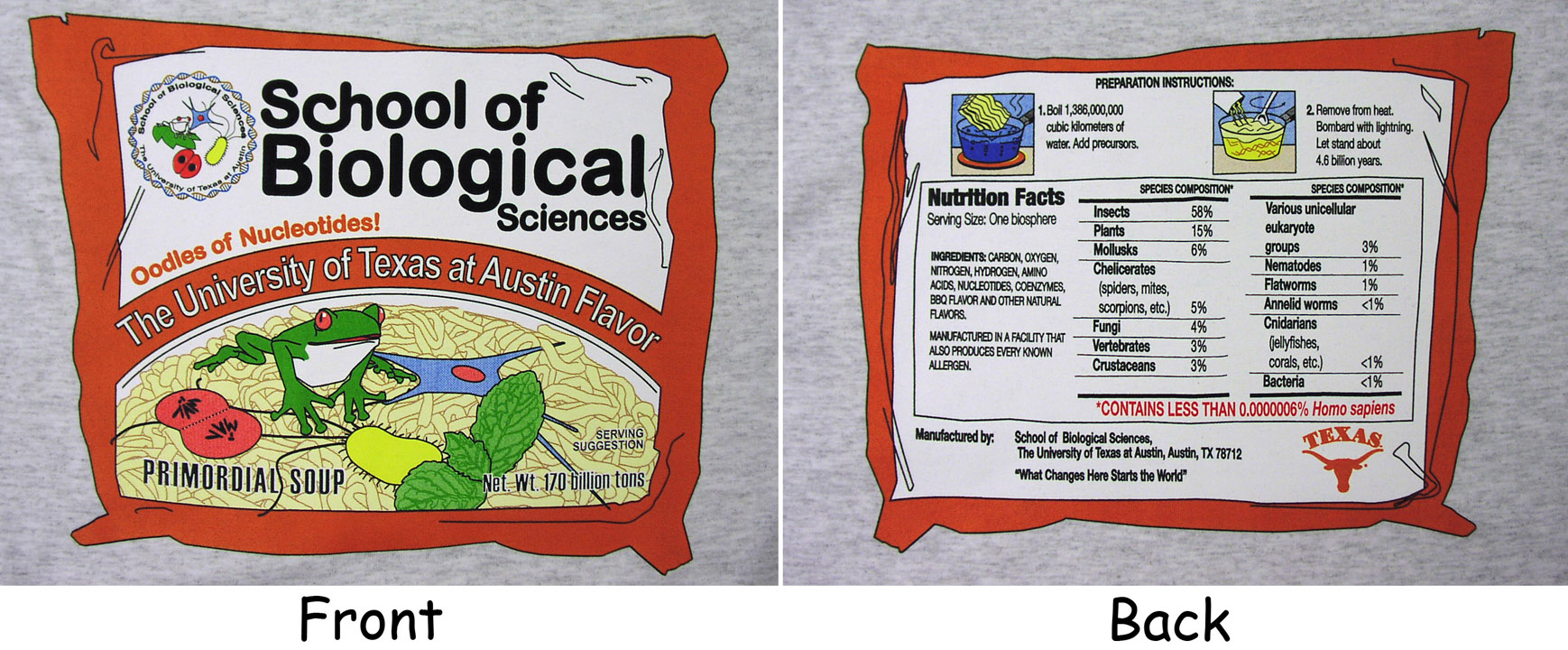
Primordial Soup

Found this amazing picture today. Reminded me of the corny science jokes my Dad used to tell. Had to share.

Where Cooking and Science Meet


      Frog legs that have been skinned get prepared to be cooked. The chef gives them a little salt and almost instantly they start twitching like mad. Why?

      Well, the reason is all in how muscles work. When the cells are intact and fresh they still have stored energy in them in the form of ATP ( Adenosine Triphosphate ). The salt activates the muscles and they use the remaining energy to contract and relax. These frog legs must have had a lot of left over ATP. Muscle stimulation does not always have to happen with salt, it can also be started with electricity. 

The Great Debate - Cannabis


      My personal feelings about the legitimacy of legalization aside, I think there is one thing we can all agree upon. Teens, and young adults who are still developing and making choices that affect their whole lives should not be smoking Marijuana. I stumbled into this article about a test recently done on adolescent and adult rats sets the stage for medical reasons why Marijuana is harmful to young minds that are still developing.
      During our teenage years is when our front parts of our brain really develop. This is a decision center of the brain. When teenagers make bad decisions it stems from here. It also affects some of our emotional outputs, making teenagers range from happy one minute to screaming the next. This test proves Marijuana does affect this development. If we legalized, regulated, and tested the over use of Marijuana in teens could diminish. This would protect the young minds of our future generations, and hopefully decrease teen suicide and adult depression.

http://www.ncbi.nlm.nih.gov/pubmed/19969082/


Laryngeal Nerve On a Dissected Giraffe

      This video is not for the faint of heart. If you have never seen a large mammal dissection this may be disturbing. Older audiences only.

      This is biological history at its finest. Finding evidence of evolutionary processes that do not fit our mainstream intelligent design theories. Thought I would share this, maybe I am the only one fascinated. Imagine being able to take a class where you could watch this, how many people get to dissect a Giraffe? I saw my first large mammal autopsy in the third grade. The result of a sudden death of one of our livestock. My Dad being a biologist thought it was a golden opportunity for learning. It was. I learned about animals having multiple stomachs, about hearts, other organs, and more. It exposed me to science at a young age, so that when I had to dissect a cow eye two years later in school it was no problem. I am thankful for having these scientific experiences, and it made me into a science lover today.

TED Talks, The Importance of Science Online


  Scientists and internet surfers everywhere are discovering the wonders of TED Talks. This site consists of short videos on a range of topics. From science to design, you can find videos relating to almost anything you find interesting. TED holds a conference, and has guest speakers to speak on their area of expertise. The speech or lecture is usually short, detailed and interesting. Some are humorous, some informative. Something for everyone. Really.
Say you are into online gaming. As someone in my 20s it has appeared many of the generations greatest minds have been lost to this past time. Even I picked up playing online games on the Xbox 360, in order to compete with my boyfriends over infatuation with gaming. Instead we argued over who got to play when because neither of us wanted to play on split screen. When I started trying to do more outdoors activities I had to quit video games cold turkey. For me there was no playing an hour a day, it was all I wanted to do if I was awake and home. So I quit playing and started seeing it as an evil impact on my generation and society in general. I just played for a couple hours this week for the first time in over 10 months. It was a video on this site that made me think twice about online gaming.


Say you are into art, maybe sculpture? Want to get to know some great modern sculpture artists? Here are the videos and lectures from the artists about their work. One I particularly liked was Reuben Margolin: Sculpting Waves in Wood and Time. An amazing sculptor that combines both art, mechanics, and math all in one amazing piece of work. The movement is stunning. I liked that all his pieces in this lecture came from one inspirational source of water and fluid movements, waves. Yet every piece is unique and has variety within his work. Pieces have variety in speed, size, material, and shape. Truly an inspirational artist.


Just want to relax and watch something funny? Many comedians has done short routines on videos for TED, including Maz Jabroni. Jabroni is a Iranian American comedian, who jokes about stereotypes and his experiences as someone of middle eastern descent. Not entirely politically correct, nor educational, but for the comedy lover this is one example of what TED Talks has to offer.


Need science in your life? Love to learn? Then watch one of the many science videos. From interesting species to inspirational and motivating videos from today’s top scientists. One of the Scientists is Noah Wilson, an expert on honey bees and how the mysterious vast disappearence of bees in urban areas has been affecting the ecosystem.


I use TED Talks daily, I like to say I learned something new everyday. I just select a short video I haven’t seen before when I have 10-15 minutes to spare online. To me it is a valuable resource online waiting to be utilized. I know several high school teachers who used TED Talks to get conversations about science flowing in the classroom. My Dad when he taught Biology used to show a video once a week just to relax the students and get them thinking about different areas of science. Not only for science teachers would this site be useful, but for design classes, engineering, and even humanities. This is a great way to supplement your knowledge if you are in one of these courses. Please share this video collection of knowledge with your friends. You might spend hours on the site your first visit so be careful! Learning online is addictive!

     Sources:
http://www.ted.com/

Wednesday, August 22, 2012

Why Go to School for Environmental Science?


What Is Environmental Science? Environmental Science is science based on natural and Earthly processes and problems. It includes conservation, wildlife management and fisheries biology and management along with forestry and many others. These scientists help protect our natural environment. They identify problems and pollutions to minimize bad health and bad population numbers in environments. Some work in a lab or office, some Environmental Scientists work out in the field collecting data first hand from the ecosystem. Many do both and work full time. For most of these jobs it is highly recommended you at least get your bachelors degree. Although most college websites will tell you most Environmental Science students go on to get their doctorate. This is not always true, and you have to be careful of University and college bias on statistics, they often will lead you to believe handing them more money is always the best option.
Choosing was easy, I enjoy hiking and the outdoors. As a traveler, I have seen many different types of landscape and animals. As a child of the Pacific Northwest, I can not say I would rather be anywhere else. There are many beautiful places in the world to be outdoors. I am biased to say the Northwest is my favorite. Not simply because I grew up here, but because of the vast diversity in landscape and climates. From the Ocean, to the Rainforest, to the Cascades, the Scablands, the glacier lakes and rivers, and beautiful evergreen forests, it is my belief that the Northwest has everything to offer.
My dad was a high school Biology teacher and I have grown up learning about science and nature. In particular about animals. My family got into raising Alpacas as live stock when I was young. A mix of my dads want to utilize the land and my mothers love for animals and respect for South American culture. After selling the herd and divorcing my parents remained within the same country community. My dad had a wooded 5 acre lot, and he was what I would definitely consider a bird expert. He know hundred of different species of birds and could tell you every type of bird that would come to his feeders. Since he passed away I inherited his estate and have decided to go back to school both in his honor and for my own benefit. His death has made me realize how important science is to me and how much the outdoors matches my spirituality and beliefs. My father never hunted but one activity he took very seriously was fishing. I was taught to fish at a young age, and have all my own gear. I don’t enjoy eating fish as much as I like catching them but no one can throw back a beautiful Northwestern Brown Trout. Seasoned right on the grill with grilled potatoes and onion on the side its truly a classic Northwestern dish, one I was raised on.
All these factors and more influenced my personal decision. There was more than that however, I had seen a figure on Environmental Science degrees that said jobs would increase 25% in the next decade. After some researching and looking at facts it was apparent in this economy I can’t afford to go to school and not come out and get a job, and not just a minimum wage job but a real one that will help me pay bills and reduce school debt. Here is some information I found out about Environmental Science.
While looking at the Bureau of Labor Statistics website, I discovered that actual figures for this job. The average pay based upon the 2010 census is $61,700 per year and $29.66 an hour. The growth of the job outlook is predicted to be 19% through 2020. This is considered an average growth by the bureau. Out of the handful of University sites I have come across during my search most of them put this number above 20%, hence the number I had first heard. The Bureau of Labor Statistics does mention that the number of increase in jobs might be lower than what actually occurs due to the growing demand higher populations are having on our environment, and the cultural awareness of ecological hazards are making this field expand more rapidly than expected.
Also the school I was able to look into has a double major program for Biology and Environmental Science. Which means I can get a teaching job if I go get certified for education. This is essential because Biology is now a state requirement for high school graduation. In the state of Washington they have just passed a statewide curriculum for science, that includes biology as a must have to receive a high school diploma. This means science elective classes, like Environmental Science are being cut all over schools, as students no longer have a choice between the two. Biology is the basis of a lot of environmental science, and is a building block to other sciences. Everyone should take Biology, but be encourage to expand and try new sciences and experiment with science. To teach science however, you almost always need a degree in what you are teaching and in a few years Environmental Sciences might be left for the college bound students.
To anyone looking at different careers in science, I encourage you to continue in science. There simply are not enough young scientists in the world. As an ending I will leave you with this inspirational video I found on TED Talks website. The video speaker is E. O. Wilson. The speech entitled Advice to Young Scientists.


Sources:

United States Department of Labor. Bureau of Labor Statistics. Occupational Outlook Handbook. New England: , 2010. Web. http://www.bls.gov/ooh/life-physical-and-social-science/environmental-scientists-and-specialists.htm.